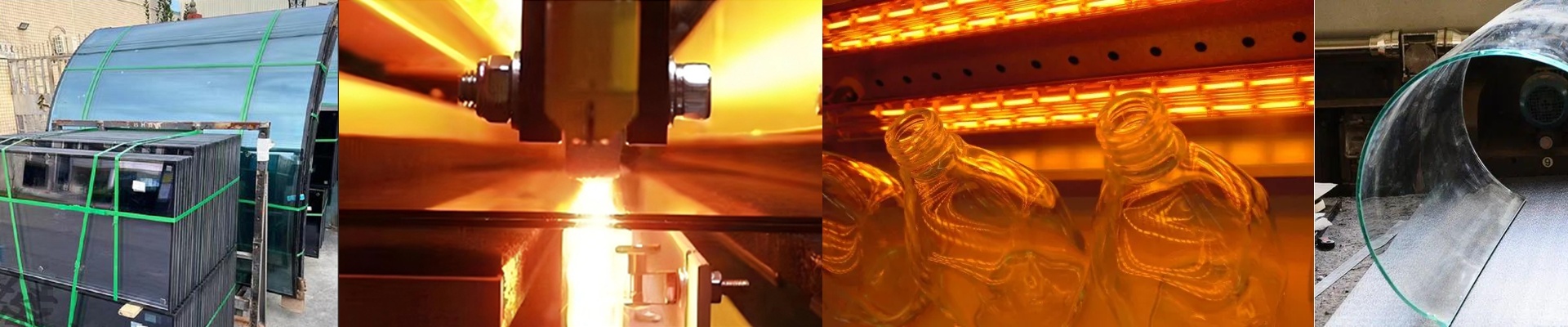
On the line, annealing isn’t about fighting thermal stress—it’s about controlling it. If the heat profile drifts, you’ll see warp, optical distortion, or latent fractures that only show up later, in cutting, lamination, or out in the field during installation. Infrared lamps give you immediate, precise response that fits the needs of float, coated, and tempered glass without fuss. What matters, technically Infrared annealing leans on short- and medium-wave NIR to punch heat into the glass fast, hitting the surface layer directly instead of leaning on convection. We match lamp power to zone length and line speed so the soak window lands right at the strain point—typically 500–570°C for most soda-lime grades—then cools through the annealing range at a steady, controlled rate. Output density is tuned to keep the thermal field even, so you don’t get edge-to-center differences that drive bow and stress marks. The quartz envelope takes thermal shock in stride, and the filament layout keeps hot spots off the glass. Why this works where we work On a bending and annealing lehr, infrared modules heat on demand, so you’re not waiting for oven mass to stabilize. That means shorter changeovers and tighter repeatability between thickness and color runs. On insulating glass sealing lines, that same fast response lets you preheat edges evenly before desiccant activation and the secondary seal, cutting the risk of uneven adhesion. Energy use drops because the lamps only deliver heat when the glass is in the zone, not to an empty chamber. Here are the things you need to keep an eye on. Infrared lamps are sensitive to reflector alignment and spacing. Expect a quick commissioning pass to set focal height and zone overlap so the profile stays flat across the glass width. Surface emissivity shifts with low-E coatings, so the control strategy has to compensate for that absorption change. Keep lamps clean, check connectors under thermal cycling, and size the supply for inrush current. When it’s done right, you get stable zone temperatures and predictable lamp life.